UAW aims to reassert political power amid divisions in Shelby Township
In Shelby Township, canvassers test the UAW's political power across Michigan by knocking on doors to unite members behind endorsed Democratic contenders.
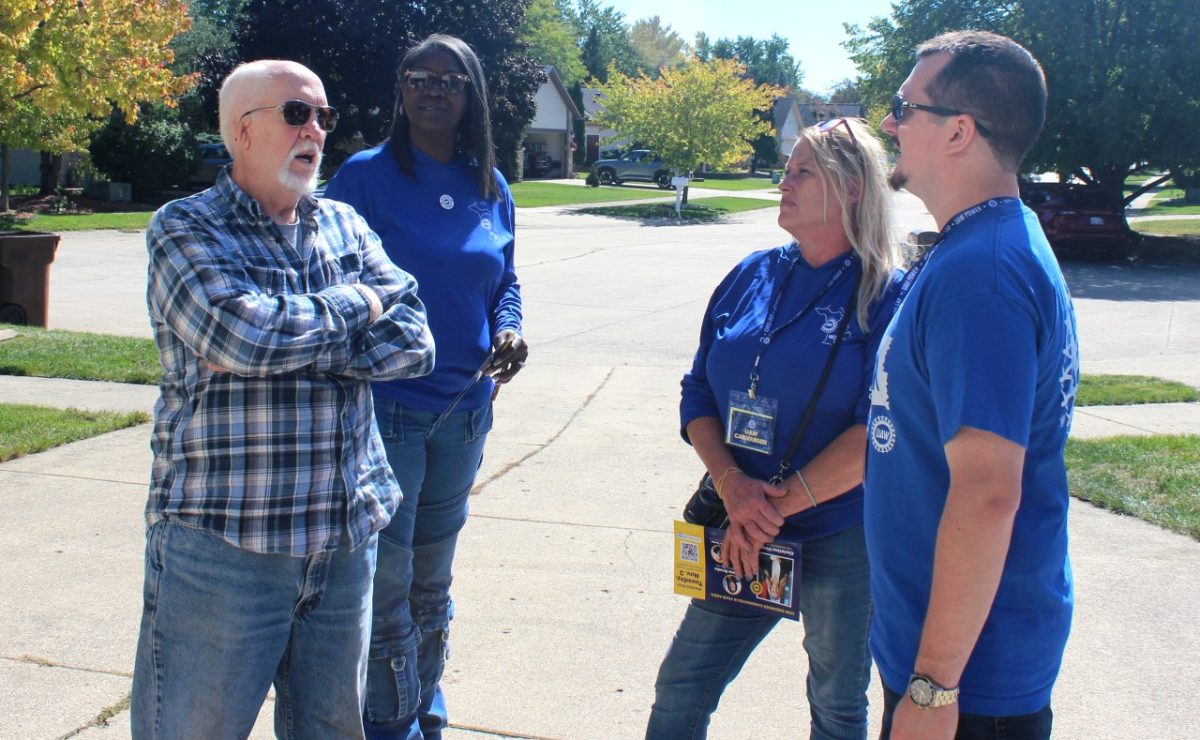
Walter Usakowski spoke with union canvassers outside his home in Shelby Township ahead of the Nov. 3 midterms. The door-to-door drive tests whether organized labor can unite its rank-and-file members behind endorsed Democratic contenders. Usakowski worked at Ford Motor Co.’s Sterling Axle Plant for more than 45 years.
The retiree backed the union slate. Still, he questioned how his former coworkers would vote. Many coworkers previously supported Republican President Donald Trump.
The union confronts past corruption scandals, a drop in membership and internal distrust. More than 10 officials have pleaded guilty since 2017 in a corruption investigation. The inquiry revealed that officials stole millions of dollars in union dues.
JJ Jewell serves on the Community Action Program executive committee. Jewell canvassed homes on a recent Saturday in Macomb County. Trump won that county by nearly 14 percentage points in 2024.
“It’s not going to be an overnight thing. Even if this election goes fantastically, that’s not mission accomplished. That means we’re 1% of the way done.”
Most members visited in the suburban area called the cost of living their main concern. They disagreed on which political party would handle it better. One voter favored Democrats, but another couple refused a union flyer and backed Trump.
Union households split their votes in 2024. Kamala Harris took more than half of those votes, while Trump won 44%.
Member Betty Anderson said she is angry with members who voted for Trump. Anderson said she doubts the union can bridge internal divides.
“I don’t think those people are ever going to be on our side. They think they have an opportunity to be in an elite class.”
Leadership changes and Senate race endorsements
Shawn Fain won election as president in 2023 on a transparency platform. Contract victories with Detroit automakers boosted his standing. Usakowski said members are starting to fall into line.
Mark DePaoli directs one of the union’s southeast Michigan regions. DePaoli said leadership held open candidate forums for members. The union then endorsed progressive Democrat Abdul El-Sayed for U.S. Senate.
El-Sayed defeated four-term Rep. Haley Stevens in the primary. Stevens previously worked as chief of staff on a federal auto bailout task force.
The union cited El-Sayed’s stance on universal healthcare and corporate money. El-Sayed wore a union pin during a debate against Republican Mike Rogers.
El-Sayed spokesperson Cole Wozniak said union backing proved critical in the primary. Wozniak said that support remains critical for the general election.
Rogers opposes federal rules under Democratic President Joe Biden promoting electric vehicles. Critics feared those regulations would close auto factories.
Rogers spokesperson Alyssa Brouillet said Rogers will champion autoworkers in the Senate. Brouillet stated that the same cannot be said for El-Sayed and union leaders.
Voter turnout efforts across Michigan
Labor professor Robert Bruno of the University of Illinois Urbana-Champaign tracks union mobilization. Bruno said campaigns succeed through direct voter contact rather than endorsements.
“You don’t win campaigns off of your endorsements. You win campaigns at the door, or at the bar, or at the union hall.”
Union ranks in Michigan fell from over 600,000 in the 1980s to roughly 350,000 today. It remains the largest labor union in the state.
Union leaders reported that about 113,000 members cast ballots early in Michigan’s August primary. Volunteers now knock on doors and phone voters across Macomb County communities like Shelby Township.
In September, the union held its Michigan political arm conference for the first time since 2018. Fain claimed reelection on Friday based on preliminary vote tallies. He spoke to reporters at the Lansing event about worker priorities.
“We are as active as we can be right now,” Fain said. He told reporters that members must steer union priorities.
Labor organizations use political action committees to endorse candidates and run voter outreach drives. Volunteers distribute campaign literature directly to households to explain organizational positions before balloting begins. State election laws govern how these coordinated political groups contact registered voters.
Field workers plan to continue home visits until the November midterms conclude.